In one line
Pulse follows 100,000 deterministic synthetic customers from lifecycle measurement to intervention estimates, temporal churn evaluation, and contact economics. Its final recommendation is intentionally conservative: continue the controlled activation test, but do not launch customer outreach under the stated assumptions.
Question
Where should a digital bank intervene across activation, retention, churn risk, and contact economics - and when should it choose not to act?
What I built
- Generated synthetic customers, events, transactions, experiments, campaigns, and product holdings, then materialized one metric layer in DuckDB with SQL validation checks.
- Separated randomized activation measurement from observational campaign estimates, using difference-in-differences and stabilized inverse-probability-of-treatment weighting under explicit claim boundaries.
- Evaluated churn and response models on later temporal holdouts, then combined risk, response, customer value, contact cost, incentive cost, and capacity in a contact policy.
- Generated six executed notebooks, tables, figures, a machine-readable results manifest, and an 11-page reviewer report from the same evidence layer.
Main result
- randomized activation effect; 95% CI +8.28 to +10.05
- +9.16 pp
- top-decile churn lift on 11,728 temporal holdout customers
- 2.673×
- customers contacted by the expected-value policy
- 0
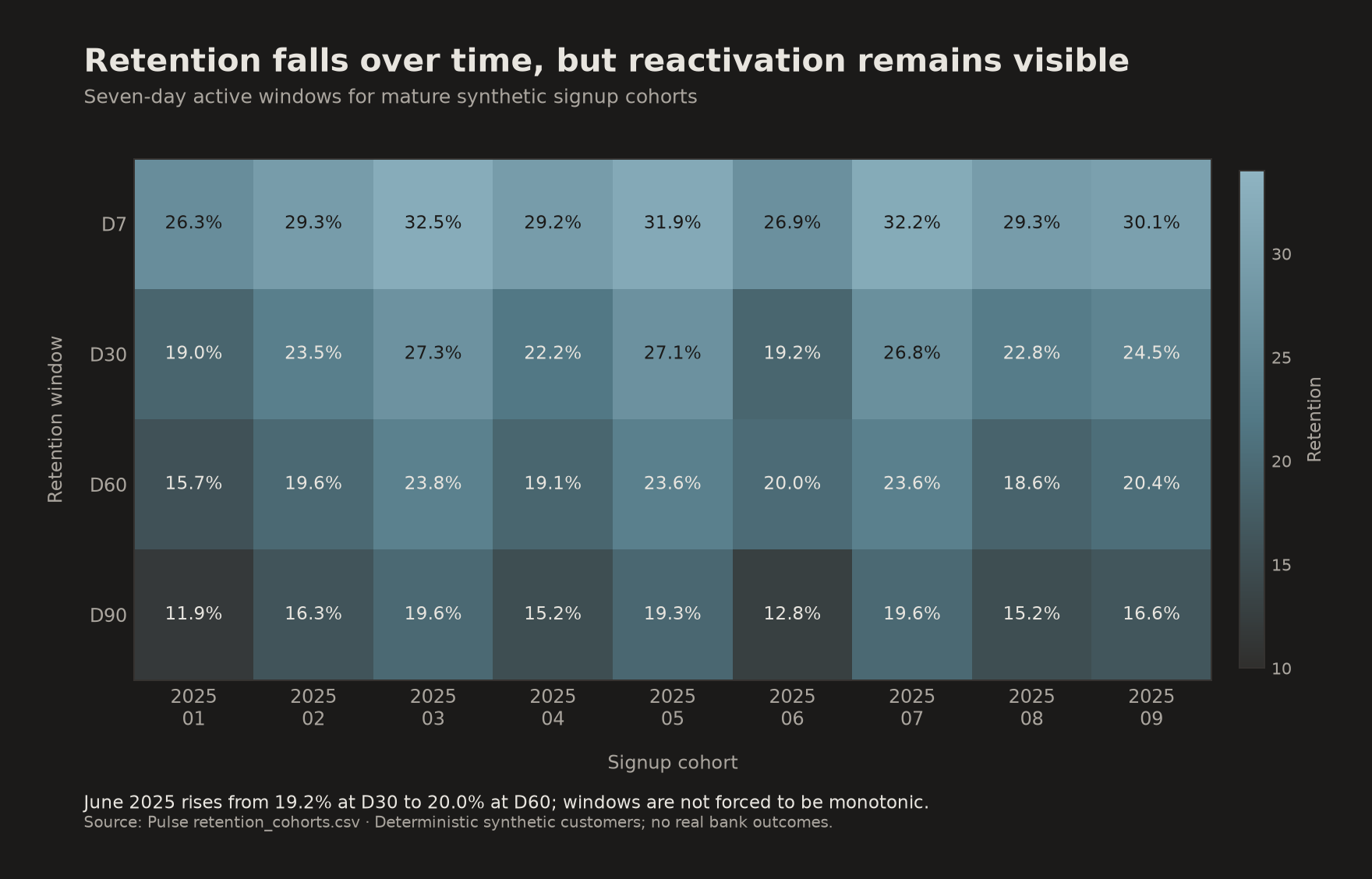
Retention figure
What the work showed
- The randomized activation experiment found a positive effect for 37,340 eligible synthetic customers, but that estimate does not establish profit or durable retention.
- Mature retention declined from 29.7% at D7 to 16.3% at D90, while cohort windows were allowed to rise when the simulation produced reactivation.
- The campaign estimates were directionally similar: +1.03 percentage points from difference-in-differences and +0.95 from weighting, subject to their observational assumptions.
- Churn ranking was useful enough to concentrate risk, but no simulated targeting strategy cleared the fictional value and cost assumptions.
What it does not prove
- Every customer, event, effect, value, and cost is synthetic. Public bank disclosures informed lifecycle structure, not the numerical results.
- Random assignment supports only the activation estimate for the defined eligible population and outcome. It does not establish profit, long-run retention, or external validity.
- The campaign estimates depend on overlap, parallel trends, measured confounding, and other observational assumptions; their confidence intervals do not capture every source of dependence.
- Churn and response scores are predictive, not estimates of incremental treatment benefit. The contact recommendation changes if the fictional economics change.
Conclusion
Pulse connects analysis to a decision without forcing a positive recommendation. The measured activation effect supports continued testing, while the economics reject broader outreach under the frozen synthetic assumptions.